

How to Use 11 Plus Practice Papers Without Overloading Your Child
Many parents preparing their child for the 11 Plus Exam eventually wonder how to use 11 plus practice papers effectively. A practice paper sits on the table while your child begins answering questions. A few minutes later, the doubts start creeping in. Is this too difficult? Should this be timed already? Why did the score drop compared to last week?
For many families, practice papers quickly become a source of confusion rather than confidence. One paper goes well, the next does not. Some children lose motivation after a difficult test, while others rush through questions because they feel pressured by the clock.
Understanding how to use 11 plus practice papers correctly can remove much of that uncertainty. Used strategically, they help children become familiar with exam formats, develop time management, and highlight areas that need more attention. Used incorrectly, they can create unnecessary stress and discourage children who are still developing the skills needed for the exam.
Research from the Education Endowment Foundation consistently shows that clear feedback and targeted practice are among the most effective ways to improve learning progress. The improvement rarely comes from repeating tests. Instead, it comes from understanding mistakes and adjusting preparation.
With the right approach, practice papers can become one of the most useful tools in 11+ preparation.
How to Use 11 Plus Practice Papers
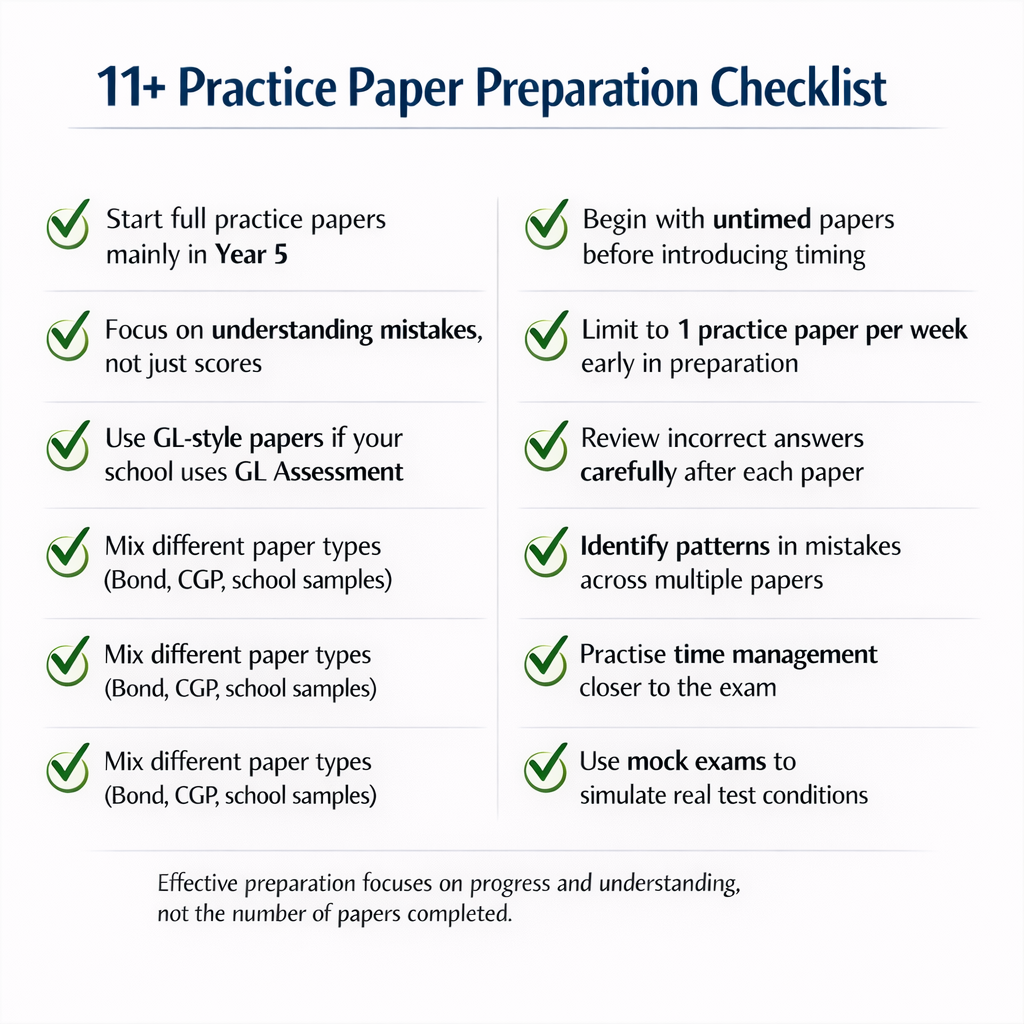
The best way to use 11 plus practice papers is to introduce them gradually, review mistakes carefully, and focus on improving weak areas rather than completing large numbers of tests. Most children begin using full practice papers during Year 5 once the core skills in comprehension, maths, and reasoning have developed.
Why Parents Need to Understand How to Use 11 Plus Practice Papers Properly
Many parents start preparation with enthusiasm. They buy practice books, download sample papers, and set aside time each week for study. Without a clear strategy, however, practice papers can quickly become overwhelming.
Parents often notice a pattern during preparation: one week goes well, and the next suddenly feels more difficult. This shift can make families question whether their child is progressing. In reality, fluctuating scores are extremely common while children are still learning how to approach exam-style questions.
Common Mistakes Parents Make When They First Introduce Practice Papers
A common mistake is introducing full practice papers before children have built strong foundations in vocabulary, comprehension, and mathematical reasoning. When this happens, low scores can feel discouraging even though the child is still developing the skills needed for the exam.
Other mistakes are just as common. Some parents focus heavily on the final score instead of reviewing mistakes in detail. Others complete several papers in a row without analysing incorrect answers. Timed practice is sometimes introduced before children fully understand the question formats, which can make the experience unnecessarily stressful.
Practice papers are most useful when they reveal which skills need more attention rather than acting as an early measure of exam readiness.
What Parents Can and Cannot Learn From 11 Plus Practice Papers When Deciding How to Use Them
Practice papers show how well a child applies their knowledge under exam-style conditions. They reveal whether a student understands instructions, manages time pressure, and recognises different question types.
However, a single paper rarely tells the whole story. Tutors often see students score lower on their first timed paper simply because they spend too long on difficult questions. Once they learn to move on and return later, their results often improve quickly.
Lower scores can reflect unfamiliar question types, difficulty concentrating for a full test length, or hesitation when facing new reasoning patterns. Looking at several papers over time provides a far more reliable view of progress.
Parents should also remember that the 11 Plus Exam may follow different formats depending on the school or exam provider. Some grammar schools use tests developed by GL Assessment, which typically include verbal reasoning, non-verbal reasoning, maths, and English. Other schools design their own assessments or use different question styles. Choosing practice papers that match the expected format helps children become familiar with the types of questions they will encounter.
Types of 11 Plus Practice Papers Parents Often Use
Parents preparing for the 11 Plus Exam will come across several types of practice papers. Each type is designed slightly differently, and understanding the main options helps families choose materials that match the exam format their child is likely to face.
Many grammar schools use tests created by GL Assessment. These exams typically include verbal reasoning, non-verbal reasoning, maths, and English. Practice papers based on the GL format are therefore widely used because their structure and question styles resemble those used in many grammar school entrance tests.
Another common resource is Bond 11+ practice papers. Bond materials are written specifically for 11+ preparation and are usually organised by age groups such as 9–10 and 10–11. Their papers often increase gradually in difficulty, which can help children build confidence before attempting full exam-style tests.
Parents also often use CGP 11+ practice books and papers. CGP resources are known for straightforward explanations and structured practice questions covering maths, English, verbal reasoning, and non-verbal reasoning. These books are frequently used to strengthen individual subjects alongside full practice papers.
Some of the most useful materials come directly from grammar schools themselves. Many schools publish sample or familiarisation papers on their admissions pages so families can see the style of questions used in that school’s entrance test.
Because exam formats vary between schools, families often use a combination of these materials during preparation. Seeing different question styles helps children become more comfortable with the types of problems that appear in the 11 Plus.
How Familiarity With Exam Format Reduces Anxiety
Once parents understand what practice papers can realistically show, another benefit becomes clear. Regular exposure to exam-style questions helps children approach the exam with greater confidence.
Many children struggle not because the questions are impossible but because the structure of the test feels unfamiliar. Timed sections, varied reasoning questions, and strict instructions can create pressure.
When children repeatedly encounter similar question styles in practice papers, they begin to recognise patterns and expectations. Instead of worrying about the structure of the test, they can concentrate on solving the questions themselves.
For example, grammar schools such as Queen Elizabeth’s School in Barnet receive thousands of applicants each year. Because of this level of competition, familiarity with exam formats and timing becomes extremely important.
Educational psychologists note that exam stress often increases when students feel unprepared or unfamiliar with testing conditions. Research discussed by the British Psychological Society explains that reducing uncertainty around assessments can help students manage exam anxiety more effectively.
When to Start: A Practical Timeline for How to Use 11 Plus Practice Papers
| Stage | Preparation Focus | Practice Paper Approach |
| Year 4 | Build core skills in vocabulary, reading comprehension, and basic maths | Introduce common 11+ question types through short exercises and untimed questions |
| Early Year 5 | Apply core skills to exam-style questions | Use occasional untimed practice papers to familiarise children with the exam structure |
| Late Year 5 | Develop exam technique and time management | Start regular timed practice papers to improve pacing and accuracy |
| Months Before the Exam | Simulate real exam conditions and build confidence | Complete full mock exams under realistic timing and conditions |
Once parents understand the purpose of practice papers, the next question usually follows quickly: When should they actually start?
Starting too early can create unnecessary pressure, while starting too late may leave little time to build exam confidence. A gradual timeline allows children to develop the skills and familiarity needed for the exam.
How to Use 11 Plus Practice Papers During Early Preparation (Year 4)
Imagine giving a full exam paper to a child who is still developing reading comprehension or vocabulary. The result is often frustration rather than progress.
In Year 4, preparation should focus mainly on building the academic foundations that later support exam success. Practice papers can still play a role, but they should mainly introduce question styles rather than measure performance.
During this stage, children benefit most from strengthening vocabulary, comprehension skills such as inference and evidence finding, arithmetic accuracy, and introductory verbal and non-verbal reasoning patterns. These skills make later practice papers far more effective.
Transitioning From Learning Exercises to Structured Practice in Year 5
As children move into Year 5, preparation typically becomes more structured. By this point, students have developed stronger academic skills and can begin applying them to exam-style questions.
Occasional full papers help students understand how the different sections of the exam work together. Parents may also introduce subject-specific papers focusing on maths, comprehension, or reasoning.
Different subjects often reveal different patterns in practice papers. Comprehension papers may show whether a child struggles with inference questions or vocabulary. Maths papers often highlight multi-step reasoning problems or careless calculation errors. Verbal reasoning papers frequently expose unfamiliar question patterns that become easier with practice.
Recognising these patterns helps parents guide revision more effectively.
Introducing Timed Papers Closer to the Exam
Once children are comfortable with question formats, timed practice becomes increasingly valuable. This usually happens in the months leading up to the exam.
Learning how to manage time is an important part of exam preparation. Students gradually become better at deciding when to move on from a difficult question and return later.
Large-scale international assessment research from the OECD shows that student performance is influenced by how well they handle test demands and assessment conditions. Gradual exposure to timed papers can help children become more comfortable managing time and pressure during the exam.
How Many 11 Plus Practice Papers Are Enough
Once practice papers become part of the study routine, many parents begin asking a different question. Instead of wondering when to start, they start wondering how many papers their child should complete each week.
It is easy to assume that more practice automatically leads to better results. In reality, too many papers can lead to fatigue and frustration.
How to Use 11 Plus Practice Papers Without Creating Burnout
Some families try to complete multiple papers in a single weekend because they believe frequent testing will accelerate progress. In practice, children often become tired and lose concentration when practice becomes too intense.
Without time to review mistakes, the learning benefit becomes limited. Instead of increasing the number of papers, it is usually more helpful to focus on improving the understanding behind each attempt.
Carefully reviewing incorrect answers, revisiting difficult topics, and strengthening weak skills often lead to greater improvement than simply completing more tests.
A Realistic Weekly Routine for How to Use 11 Plus Practice Papers
A manageable routine usually produces better results than an intense schedule. Many families follow a simple weekly pattern in which one practice paper or timed section is completed early in the week, followed by a careful review of mistakes.
The remaining study time can then focus on revisiting weak areas and strengthening the skills that caused difficulty. As the exam approaches, the number of papers may gradually increase, but the emphasis should remain on steady improvement.
Parents often ask what scores indicate progress. Results vary depending on the difficulty of the paper, but tutors frequently see Year 5 students scoring between 60 and 75 percent while they are still developing exam techniques. Scores usually improve as students become more familiar with question styles and time management strategies.
How to Use 11 Plus Practice Papers to Improve Weak Areas
Once practice papers are part of the routine, the real value lies in understanding what the results reveal. Instead of focusing only on scores, parents can use each paper to guide targeted revision.
How to Use 11 Plus Practice Papers to Identify Patterns in Mistakes
Instead of focusing on individual incorrect answers, look for patterns across several papers.
For example, repeated errors may appear in:
- inference questions in comprehension passages
- multi-step maths problems
- certain verbal reasoning question types
Recognising these patterns helps parents focus revision on the areas that will make the biggest difference.
Turning Mistakes Into Targeted Revision Sessions
Once weak areas become clear, targeted revision becomes much more effective than simply repeating practice papers.
Students often improve quickly when they focus on specific skills such as identifying evidence in comprehension passages, strengthening arithmetic accuracy, or learning strategies for recurring reasoning question formats.
Tracking Improvement Across Multiple Papers
Tracking results across several practice papers helps parents understand whether preparation strategies are working. Instead of focusing only on individual scores, parents should look for trends across several attempts.
Improvements in timing, fewer repeated mistakes, and greater confidence when approaching challenging questions often signal real progress.
Using Mock Exams to Simulate the Real Test Environment
As the exam approaches, mock tests become especially helpful because they recreate the pressure and structure of the real exam.
Mock exams allow children to experience:
- full exam-length concentration
- strict time limits
- realistic test environments
These experiences help reduce surprises on the actual exam day and build confidence.
Final Thoughts
Preparing for grammar school entrance exams can feel overwhelming for many families. Parents often worry whether they are doing too much, starting too early, or interpreting practice paper results incorrectly.
Understanding how to use 11 plus practice papers brings structure to the preparation process. When used thoughtfully, practice papers help families identify learning gaps, strengthen exam skills, and build familiarity with the types of questions students will face.
However, interpreting practice results and planning revision can still be challenging without guidance. This is where structured preparation makes a difference.
At Academic Success, experienced tutors help students review practice papers, strengthen weak areas, and develop exam strategies tailored to the specific 11+ tests used by local schools. Mock exams and personalised feedback help students build confidence while preparing for real exam conditions.
If you would like support preparing your child for the 11 Plus Exam, contact Academic Success to learn how their programmes can guide your child through every stage of the preparation journey.
Frequently Asked Questions
When should my child start using 11 plus practice papers?
Most children begin encountering exam-style questions in Year 4, but full practice papers are typically more effective in Year 5 once key skills such as comprehension, vocabulary, and reasoning have developed. Early preparation should focus on building these foundations while gradually introducing question formats. As children become more comfortable with the structure of the 11 Plus Exam, full practice papers can help them understand how the different sections work together and prepare them for timed assessments.
How many 11 plus practice papers should my child do each week?
Many students benefit from completing one practice paper or one timed section per week during the early stages of preparation. This gives families enough time to review mistakes and strengthen weak areas before attempting another paper. Closer to the exam, some students increase practice to two papers per week, but improvement usually comes from analysing errors and revisiting difficult topics rather than simply completing a larger number of tests.
Should 11 plus practice papers be timed?
Timed practice becomes helpful once a child understands the question types and strategies used in the exam. Introducing strict time limits too early can create pressure and reduce confidence. Many students begin timed practice a few months before the exam, which allows them to develop pacing strategies such as moving past difficult questions and returning to them later while maintaining accuracy.
Are practice papers enough to prepare for the 11 plus exam?
Practice papers are helpful, but they work best as part of a broader preparation plan. Strong results in the 11 Plus Exam often depend on developing vocabulary, improving comprehension skills such as inference and evidence finding, strengthening reasoning abilities, and practising mathematical problem-solving. Practice papers are most effective when they highlight weak areas that can then be improved through targeted revision.
What should parents do after their child completes a practice paper?
After a child completes a practice paper, parents should review the questions carefully rather than focusing only on the score. Looking for patterns in mistakes can reveal specific learning gaps, such as difficulty with inference in comprehension, multi-step maths problems, or unfamiliar verbal reasoning patterns. Discussing these errors and practising similar questions helps turn each paper into a learning opportunity that gradually improves both understanding and exam confidence.
Do 11 plus practice papers predict the real exam score?
Practice papers can show how comfortable a child is with exam-style questions, but they do not reliably predict the final 11+ score. The real exam uses standardised scoring, which adjusts results based on age and the overall performance of other candidates. Practice papers also vary in difficulty, so a score on one paper may look strong while another paper may feel harder. Rather than focusing on exact marks, parents should look for steady improvement across several papers. Fewer repeated mistakes, better time management, and greater confidence when tackling unfamiliar questions are stronger signs that a child is becoming ready for the exam.
Which practice papers are closest to the real 11+ exam?
The papers that feel closest to the real exam are usually those that match the format used by the grammar schools your child is applying to. Many schools use tests designed by GL Assessment, which typically include combinations of verbal reasoning, non-verbal reasoning, maths, and English. Practice papers based on this format often resemble the structure and question styles used in those exams. Some schools also publish sample or familiarisation papers on their admissions pages, which can provide the most accurate indication of the exam style. Materials from publishers such as Bond 11+ and CGP 11+ are commonly used during preparation because they cover the same subjects and reasoning skills tested in many grammar school entrance exams. However, no practice paper can replicate the real test exactly, so it helps children to practise with a variety of papers while focusing on the skills behind the questions.


You may also like

11 Plus Vocabulary Boost Tips
11 Plus English Comprehension Tips